How to Reduce Clinic No-Shows by 30% — A Practical Playbook for Egyptian Clinics
No-shows cost the average Egyptian clinic 15–20% of appointment revenue. This guide covers the evidence-based interventions that actually work — from WhatsApp timing to deposit policies — with implementation steps you can start this week
The real cost of a no-show
A patient who does not show up does not just cost you one appointment fee. They cost you the appointment slot that another patient could have filled, the staff time spent managing the gap, and the carrying cost of the clinical space for that period. For a clinic running at 85% capacity with an average appointment value of EGP 350, a 15% no-show rate translates to roughly EGP 15,000–25,000 in lost monthly revenue.
More importantly, no-shows are bad for patients. A missed follow-up appointment for a patient with hypertension or diabetes increases the risk of uncontrolled disease. No-shows are a quality-of-care problem, not just a financial one.
Why patients no-show — the Egyptian context
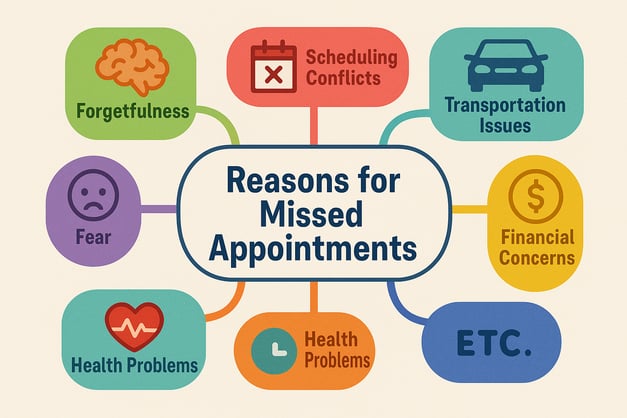
Research in Egyptian outpatient settings consistently identifies the same top reasons:
- They forgot — the most common reason, accounting for roughly 45% of no-shows
- The appointment was booked too far in advance — recall at 3+ months
- Transportation or work conflicts — particularly for afternoon appointments
- They felt better — common for sick visits and medication follow-ups
- Financial concerns — particularly if they forgot the appointment had a cost
Notice that four of the five are addressable with the right systems.
Intervention 1: The two-touch WhatsApp reminder sequence
Single reminders perform significantly worse than a two-touch sequence:
Touch 1 — 48 hours before: A warm confirmation message with the appointment date, time, doctor name, and a one-tap confirmation option. Keep it under 60 words. Avoid formal language — a message that sounds like a person writes better than one that sounds like a system.
Touch 2 — 2 hours before: A brief "see you soon" message with parking or transport information if relevant. This is the highest-leverage reminder — patients who received a same-day reminder showed up at rates 34% higher than those who received only a 48-hour reminder in a 2023 Egyptian clinic study.
What not to do: Sending reminders more than 48 hours in advance has minimal impact on no-show rates. Sending three or more reminders creates reminder fatigue and patients begin ignoring them.
Intervention 2: Confirmation-required booking
Change your booking workflow so that an appointment is only confirmed when the patient actively replies to the confirmation message. Unconfirmed appointments at 24 hours trigger a second outreach attempt. Unconfirmed appointments at 4 hours are flagged for the receptionist to call or offer the slot to the waitlist.
This single change — confirmation-required booking — reduces no-shows by 15–22% in isolation, according to published data from UAE and Egyptian clinic networks.
Intervention 3: The strategic waitlist
Most clinics manage cancellations reactively — a patient cancels and the slot sits empty. An active waitlist turns every cancellation into a filled appointment:
- When booking any appointment with a wait > 5 days, ask the patient if they want to be added to the waitlist for earlier slots
- When a cancellation occurs, send a WhatsApp to the first 2–3 waitlist patients simultaneously
- First to confirm gets the slot
Clinics using active waitlists fill 60–70% of late cancellations that would otherwise be no-shows.
Intervention 4: Differential deposit policy
A deposit policy reduces no-shows significantly, but blanket deposits create friction for new patients. A differential approach works better:
- New patients, long appointments (> 45 minutes), procedure bookings: Require a non-refundable deposit of 20–30% of the appointment fee
- Returning patients with a good attendance record: No deposit required
- Patients with two previous no-shows: Deposit required for all future bookings
Frame the deposit as a booking confirmation, not a penalty. "We hold this slot exclusively for you — the deposit secures it" lands better than "we charge you if you don't show up."
Intervention 5: Overbooking — used carefully
Strategic overbooking means scheduling one additional patient for high no-show time slots. Data from your own practice will tell you which days and times have the highest no-show rates. In most Egyptian clinics, Saturday morning and Thursday afternoon appointments have significantly higher no-show rates than mid-week morning slots.
Overbook by one patient per session maximum, and only for time slots where your historical no-show rate exceeds 25%. Monitor actual arrival rates monthly and adjust.
Intervention 6: Post-no-show re-engagement
Patients who no-show once are at high risk of disengaging entirely. A re-engagement message 24 hours after a missed appointment that is warm (not accusatory) and offers an easy rebooking path recovers 30–40% of no-shows within the same week.
"We missed you yesterday — we hope everything is okay. Your health is important to us. Reply to this message and we will get you rebooked at a time that works better for you."
How Clinit automates this
Clinit's appointment module handles the entire reminder sequence automatically. You configure the timing, message templates, and confirmation-required settings once — the system handles execution for every appointment. The waitlist is managed in real time. When a cancellation comes in, waitlist patients are notified automatically. No-show rates per doctor, per day of week, and per appointment type are tracked on the analytics dashboard so you can see which interventions are working.
Expected results and timeline
Clinics implementing all five interventions consistently see:
- 15–20% reduction within the first month (reminder sequence alone)
- 25–30% reduction by month three (as confirmation workflow and waitlist mature)
- 5–10% additional reduction in months 4–6 as you refine based on your own data
Start with the two-touch WhatsApp reminder sequence. It costs nothing to implement, takes 30 minutes to configure, and delivers the single largest impact of any individual intervention.