BPE Periodontal Charting: The Complete Clinical Guide for Dental Teams
A step-by-step guide to the Basic Periodontal Examination — how to score all six sextants correctly, interpret codes 0–4, apply AAP 2017 staging, and use BPE data to drive recall intervals and treatment decisions
What is BPE and why does it matter?
The Basic Periodontal Examination (BPE) is the standard screening tool recommended by the British Society of Periodontology and the Egyptian Dental Association for all adult patients. It gives you a rapid, reproducible snapshot of periodontal health across six sextants — upper right, upper anterior, upper left, lower left, lower anterior, lower right — in under five minutes.
Done consistently, BPE does three things:
- Flags patients who need further periodontal assessment
- Drives appropriate recall intervals
- Provides a legally defensible baseline record in every patient file
The six sextants and the WHO probe
Each sextant must contain at least two teeth (not counting third molars). If a sextant has only one tooth, that tooth is included in the adjacent sextant. You use the WHO periodontal probe — a ball-ended probe with a black band between 3.5 mm and 5.5 mm — and record the single highest code found in each sextant.
BPE codes explained
Code 0
Healthy — no bleeding on probing, no calculus, no pockets. No treatment needed. Recall at 24 months for low-risk patients.
Code 1
Bleeding on probing but no calculus and no pocketing (black band fully visible). Oral hygiene instruction only. Reassess at next visit.
Code 2
Calculus or plaque-retentive factors present. Black band still fully visible (pocket depth ≤ 3.5 mm). Scale and oral hygiene instruction. Recall at 12 months.
Code 3
Black band partially visible — pocket depth 3.5–5.5 mm. This is the threshold that triggers a full periodontal assessment in the affected sextant. Root surface debridement, oral hygiene instruction, and reassessment at 8–12 weeks.
Code 4
Black band disappears entirely — pocket depth > 5.5 mm. Full periodontal assessment mandatory for the entire dentition. Specialist referral should be considered. Complex treatment planning required.
Code *
Recorded in addition to the highest code when a furcation involvement is detected in any tooth in that sextant. A sextant scoring Code 3* is significantly more complex than Code 3 alone.
AAP 2017 Staging and Grading
Since 2017, the American Academy of Periodontology classification has replaced the older chronic/aggressive terminology. BPE is your entry point — once a patient scores Code 3 or 4, you proceed to full-mouth charting to determine:
Stage (severity):
- Stage I: Interdental CAL 1–2 mm, radiographic bone loss coronal third, no tooth loss
- Stage II: CAL 3–4 mm, moderate bone loss, ≤ 4 mm pocket depths
- Stage III: CAL ≥ 5 mm, bone loss extending to mid-third or beyond, tooth loss ≤ 4 teeth
- Stage IV: As Stage III plus masticatory dysfunction, ≥ 5 teeth lost
Grade (risk and progression):
- Grade A: Slow progression, no risk factors, non-smoker, normoglycaemic
- Grade B: Moderate progression, smoking ≤ 10 cigarettes/day, HbA1c < 7%
- Grade C: Rapid progression, smoking > 10/day, HbA1c ≥ 7%, or other systemic risk factor
Setting recall intervals from BPE
The BSP 2020 guidelines recommend:
| Highest BPE code | Minimum recall interval |
|---|---|
| 0 or 1 | 24 months (adults), 12 months (under 18) |
| 2 | 12 months |
| 3 | 3–6 months after treatment |
| 4 | 3 months during active treatment phase |
Common charting errors to avoid
Recording the average instead of the highest. BPE requires the single worst score per sextant — never an average of the six readings you took.
Skipping sextants with one tooth. That tooth must be allocated to an adjacent sextant, not ignored.
Forgetting the asterisk. Furcation involvement changes the treatment plan significantly. If you feel the probe dip into a furcation, the asterisk must be recorded.
Charting without walking the probe. You must walk the probe around the full circumference of the index teeth in each sextant — not just take one mesial and one distal reading.
How Clinit handles BPE
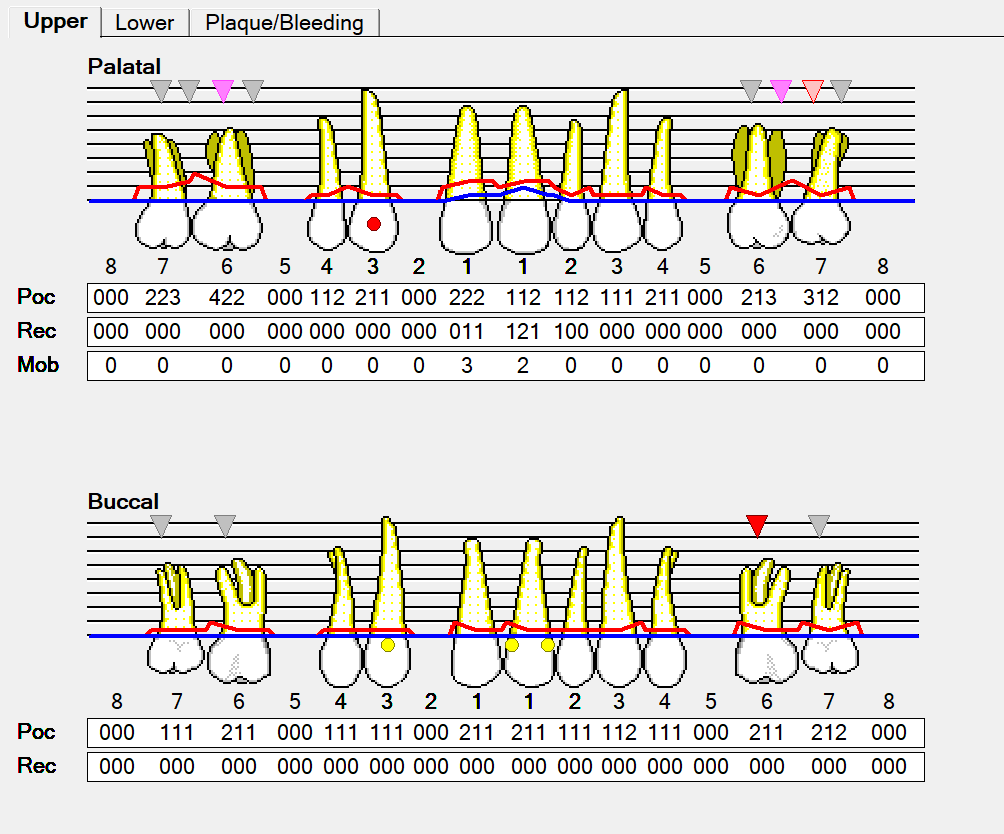
Clinit's dental module records all six sextant codes with bleeding on probing, recession, mobility, and furcation flags per sextant. Trend charts across visits let you see at a glance whether a patient's periodontal status is improving or deteriorating. AAP 2017 stage and grade are calculated automatically when you complete the full-mouth chart. Recall intervals are suggested based on the highest code recorded, and overdue BPE examinations appear on the dashboard before the patient arrives.
Summary
BPE is a five-minute examination that protects your patients and your practice. Scored correctly and recorded at every new patient visit and regular recall, it gives you an evidence-based foundation for all periodontal treatment decisions. Paired with full-mouth charting when indicated, it ensures no case of periodontitis progresses silently through your practice.


