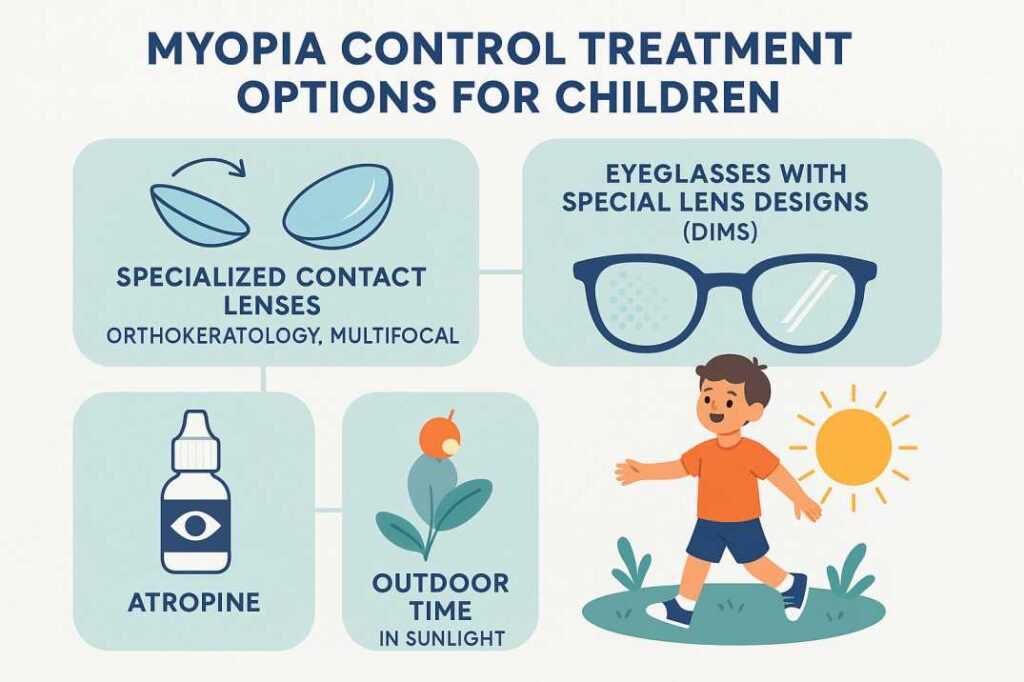
Myopia Management in Children: Axial Length Tracking, Interventions, and Clinical Protocols
A clinical guide to managing progressive myopia in children — how to measure and interpret axial length progression, when to initiate orthokeratology vs atropine vs MiSight lenses, how to set progression targets, and how to communicate prognosis to parents.
The myopia epidemic in the Middle East and Egypt
Myopia (short-sightedness) affects an estimated 30–40% of school-age children in urban Egypt — a proportion that has doubled in the last generation. The primary drivers are well-established: reduced time outdoors, increased near work (screens and reading), and genetic predisposition. What is less well understood in clinical practice is that childhood myopia is not just a refractive inconvenience — it is a progressive ocular disease that increases the lifetime risk of myopic macular degeneration, retinal detachment, glaucoma, and cataract in proportion to the final myopic refraction reached.
A child who reaches -1.00 D by age 7 and progresses at 0.75 D per year without intervention will likely end up at -8.00 to -10.00 D by adulthood — placing them in the high myopia category where the risk of vision-threatening complications is 40 times higher than in emmetropia.
Myopia management means actively slowing that progression, not just prescribing updated spectacles each year.
The key metric: axial length
Spectacle refraction changes are a downstream indicator of what is actually happening — the eye is growing too fast. Axial length (AL) measurement with optical biometry is the primary monitoring metric in modern myopia management.
Normal axial length at different ages:
- Age 6: 22.0–22.5 mm
- Age 10: 23.0–23.5 mm
- Age 14: 23.5–24.0 mm
Concerning progression rates:
- AL growth > 0.3 mm/year in children under 12: High progression — consider active intervention
- AL growth > 0.2 mm/year in children 12–15: Moderate progression — discuss intervention options
- AL growth < 0.1 mm/year: Slow progression — monitor every 6–12 months
Why axial length beats refraction for monitoring: Cycloplegic refraction has measurement variability of ±0.25 D between visits, which can mask genuine progression. Axial length measurement with optical biometry has an accuracy of ±0.01 mm, making it far more sensitive as a monitoring tool.
Risk stratification
The COMET study (Collaborative Longitudinal Evaluation of Ethnicity and Refractive Error) identified the key predictors of fast myopia progression:
- Age of onset < 8 years: Children who become myopic early reach higher final refraction
- Two myopic parents: Approximately 50% higher progression rate
- Refraction > -1.50 D at first presentation
- Esophoria at near
- Less than 90 minutes of outdoor time per day
- AL/CR ratio > 3.0 (axial length/corneal radius — a measure of relative ocular elongation independent of absolute AL)
Children with three or more risk factors should be offered active myopia management rather than watchful waiting.
Intervention options and efficacy
Low-concentration atropine (0.01–0.05%)
Atropine eye drops are the most extensively studied myopia control intervention. The ATOM2 and LAMP studies established the efficacy and safety profile:
- 0.01% atropine: Slows progression by approximately 50–60% with minimal side effects (minimal photophobia, no significant near blur at this concentration)
- 0.05% atropine: Approximately 67% slowing of AL progression in the LAMP study — the current preferred concentration for most patients
- 0.1–1.0% atropine: Higher efficacy but significant photophobia and near-vision blur; "rebound effect" on discontinuation can reverse some of the benefit
Protocol: One drop at bedtime, once daily. Prescribe in 3-month bottles. Review AL every 6 months — if progression is still > 0.2 mm per 6-month period, consider stepping up to 0.05% or adding a second intervention.
Duration: Current evidence supports continuation until age 14–15 or until AL progression is < 0.1 mm/year for two consecutive 6-month periods.
Orthokeratology (Ortho-K)
Ortho-K lenses are rigid gas-permeable lenses worn overnight that temporarily reshape the cornea to correct daytime vision. The peripheral defocus created by Ortho-K is believed to slow axial elongation by changing the peripheral retinal image.
Efficacy: Meta-analyses show Ortho-K slows AL progression by 35–60% compared to spectacles. Less consistent evidence than atropine, but the combination of Ortho-K + low-dose atropine shows approximately 70% slowing in some studies.
Ideal patient: Age 8–14, low to moderate myopia (-0.75 to -5.00 D), regular corneal topography, motivated parents who will comply with lens care protocol.
Risks: Microbial keratitis (0.8 per 10,000 lens-years with proper hygiene protocols). Corneal staining in the first 1–2 months of wear.
MiSight and myopia-control spectacle lenses
MiSight 1-Day (CooperVision) and DIMS spectacle lenses (Hoya) create peripheral defocus to slow axial growth:
- MiSight: FDA-approved myopia control soft contact lens. 59% reduction in myopia progression in the 7-year MiSight study. Suitable from age 8+.
- DIMS lenses: 52% reduction in refraction progression in the 2-year Hong Kong study. Useful for children who are not ready for contact lenses.
Setting progression targets and communicating prognosis to parents
Parents want to know: "How myopic will my child be as an adult?" The Brien Holden Vision Institute progression calculator (available at bhvi.org) estimates final refraction based on current age, refraction, and AL, with and without intervention.
Frame the goal clearly: "Without treatment, we estimate your daughter will reach approximately -8 D by age 20. With atropine drops from now, we project she will reach approximately -4.5 D — still myopic and needing glasses, but at a much lower risk of eye disease."
How Clinit tracks myopia management
The Clinit optical module records AL measurements from optical biometry at each visit, plots them on a growth chart against age-expected norms, and calculates the 6-month and 12-month progression rate automatically. Intervention type, start date, concentration (for atropine), and lens parameters (for Ortho-K) are linked to the AL trend. Parents can see the progression chart in the patient portal — seeing a flattening curve is one of the most powerful motivators for treatment adherence.


